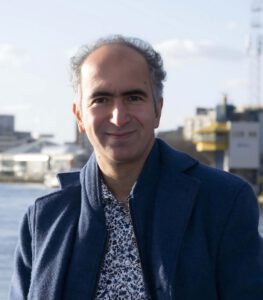
Reza Sardari

Reza Sardari (born 1975, Iran) trained as a legal adviser. In Iran, he combined his work as a legal officer with journalistic activities as a freelance reporter. After fleeing to the Netherlands in 2012, he continued working as a journalist and activist. His clients are primarily international Farsi-speaking media outlets and civil society organizations. 

Reza has published investigative stories about the Iranian political system and worked as a freelance project manager on a project focused on the rights of Iranian detainees. In addition, he collects stories from political prisoners and political movements in Iran.

Since 2022, Reza has collaborated with RFG Media, opening a pathway to Dutch media. He has also sought to further develop his investigative journalism skills in the Netherlands by completing training at the Open Eyes Institute, and he now conducts research projects with the Open Eyes Collective. He is currently working on a research project on the circumvention of human rights sanctions and refugees rights.

Reza is also the founder of the Diversiteit op Niveaus foundation, which focuses on cultural diversity.

Expertise

Investigative journalism | Human rights | Iranian politics | Political prisoners | Refugee rights | Sanctions evasion | Freelance journalism | Media & communication | Project management | Civil society | Cultural diversity | Activism | Legal advisory | International media (Farsi-language media)

Recent publications

Een crimineel kan geen religieus leider zijn

Het Iran achter de opstand

Chemical and Pharmaceutical Weapons Used Against Protests in Iran?

Leven zonder spiegel

Het was voor mij een droom om als journalist in Nederland kunnen werken

Featured Interview

The crackdown and mass killing of protesters in January 2026 (Dey 1404) has been so extensive that a UN Special Rapporteur has warned of possible “crime against humanity,” and Amnesty International has called for the case to be referred to the UN Security Council. Alongside extensive reports of live fire, some testimony suggests something else may have been deployed as well: pharmaceutical-based agents and other incapacitating chemical substances.

In a report based on eyewitness testimony from several Iranian cities, accounts describe security forces using tear gas and other chemical agents at the same time as shooting at protesters. Witnesses described effects that went beyond ordinary tear gas, including severe physical and respiratory harm as well as movement-related impacts such as sudden loss of balance, inability to stand or walk, and abrupt immobilization.

Reported symptoms include burning eyes and skin, acute breathing distress, repeated coughing, coughing up blood, dizziness, sudden weakness, fainting, loss of balance, and inability to move. In some accounts, protesters say they were incapacitated after inhaling chemical substances and then shot at while on the ground.

Witnesses also described the widespread presence of uniformed forces, the Basij, and plainclothes agents, along with vehicles used to remove the wounded and the bodies of those killed.

Two European political figures have also claimed that chemical agents were used during the repression. On January 17, 2026 (27 Dey 1404), a former UK Foreign Office minister told GB News, citing what he called a “credible report,” that there were signs the Islamic Republic may have used chemical or toxic substances against protesters.

A Dutch member of the European Parliament also accused the Islamic Republic of using chemical weapons against protesters while criticizing several European governments for opposing the designation of the Revolutionary Guards as a terrorist organization.

Contact

LinkedIn profile

Email resa1354@proton.me